Examining Certification Standards' Effects on Multiplier Activation Sequences in Licensed Portable Gaming Applications
Erik Powell · Jun 19, 2026
Examining Certification Standards' Effects on Multiplier Activation Sequences in Licensed Portable Gaming Applications
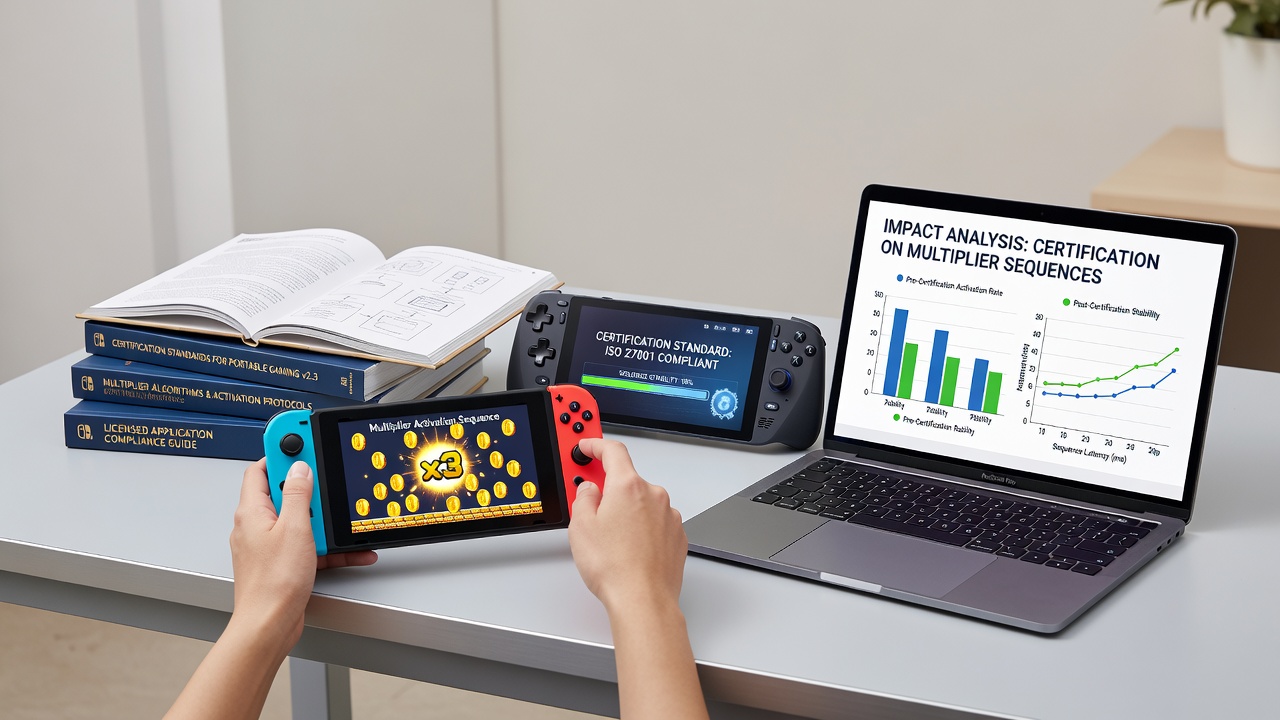
Certification standards shape how multipliers activate within licensed portable gaming applications by establishing rigorous testing protocols that developers must follow before release. These standards come from independent laboratories and regulatory bodies that evaluate random number generators along with sequence triggers to confirm consistent performance across reel based and card based titles. Data from the New Jersey Division of Gaming Enforcement indicates that applications passing full certification cycles experience fewer deviations in multiplier timing compared to pre audit versions and the process requires repeated simulations that map activation probabilities under various load conditions.Core Testing Protocols and Their Reach
Independent testing houses apply frameworks such as those developed by Gaming Laboratories International to verify that multiplier sequences align with declared mathematical models, and the evaluations include millions of simulated spins or hands to detect clustering or bias that could alter payout rhythms. Researchers have observed that certified sequences maintain activation rates within narrow tolerance bands even when network latency fluctuates during mobile sessions while uncertified builds sometimes show premature or delayed triggers once deployed. Observers note that portable platforms introduce additional variables including device specific rendering engines and operating system updates that certification labs now incorporate into extended test matrices.
Standards also address how progressive multipliers interact with bonus rounds and the checks confirm that each stage unlocks only after documented conditions occur rather than through external manipulation. Figures released in June 2026 by several North American regulators reveal that applications undergoing quarterly re certification maintain stable multiplier distributions over extended play periods whereas those with lapsed audits display measurable drift in activation frequency.
Regional Regulatory Variations and Implementation
Different jurisdictions impose distinct layers of scrutiny that influence how quickly developers can iterate on multiplier mechanics, and European authorities such as the Malta Gaming Authority require source code reviews alongside live environment testing that captures real time activation logs from portable devices. In contrast North American state level agencies often focus on outcome reproducibility and demand that any change to multiplier weighting triggers a fresh certification round before users encounter the updated sequences. Those who've studied cross border deployments find that applications certified under multiple frameworks tend to exhibit more predictable behavior because overlapping requirements force tighter control over random seed handling and state saving procedures.

Impact on Player Experience and Platform Stability
Players encounter smoother progression through multiplier tiers when applications adhere to current certification benchmarks because the underlying code avoids edge cases that produce unexpected jumps or stalls, and telemetry collected by operators shows reduced support tickets related to bonus discrepancies after certification renewals. Platform operators report that certified titles integrate more reliably with existing loyalty systems since activation events follow documented patterns that loyalty engines can track without custom exceptions. Data indicates that portable gaming applications released after full compliance checks reach higher session completion rates because users trust the consistency of rewards displayed on screen.
Technical teams at development studios adjust multiplier logic iteratively during the certification window and the feedback loops from lab reports often lead to refined trigger thresholds that preserve intended volatility while satisfying audit criteria. One case documented by industry analysts involved a reel title whose multiplier chain required recalibration three times before the sequence satisfied both fairness and entertainment value metrics set by the testing authority.
Future Trends in Certification and Sequence Design
Emerging standards increasingly incorporate machine learning assisted anomaly detection to scan for subtle patterns in multiplier activation that traditional statistical tests might overlook, and early adopters of these methods have shortened the time between submission and approval. Regulatory bodies continue to expand test suites to cover cloud based game engines and cross device synchronization that portable applications rely upon for seamless play, and the result appears in more robust sequence handling that survives operating system upgrades without reintroducing drift. Industry reports from organizations such as the Gaming Standards Association highlight ongoing work to harmonize certification requirements across regions so that a single audit can satisfy multiple markets while still protecting the integrity of multiplier mechanics.
Conclusion
Certification standards continue to define the boundaries within which multiplier activation sequences operate in licensed portable gaming applications and the interplay between testing protocols and technical implementation determines both compliance and user experience consistency. Ongoing refinements to these standards reflect the evolving nature of mobile platforms and the need for verifiable fairness across all game variants, and the data gathered through sustained regulatory oversight provides the foundation for future improvements in sequence reliability and platform trust.